

Batu Kalde Site is a Hindu/Buddhist building structure located in the Pananjung area, Pangandaran. At that place, stone blocks were found, either still buried in the ground or scattered on the ground. In addition, there are statues of Nandi, yoni, phallus, and temple structures that are still embedded in the ground.
Based on surface observations, there is a building structure in the form of stone blocks that have been eroded by sea water, because the site is often submerged in sea water during high tide. The interesting thing is that among the piles of stones there is a yoni with a broken top, a statue of Nandi, and a pedestal on top of a convex circle above a low square shape, the corners of which are decorated with cylindrical corners.
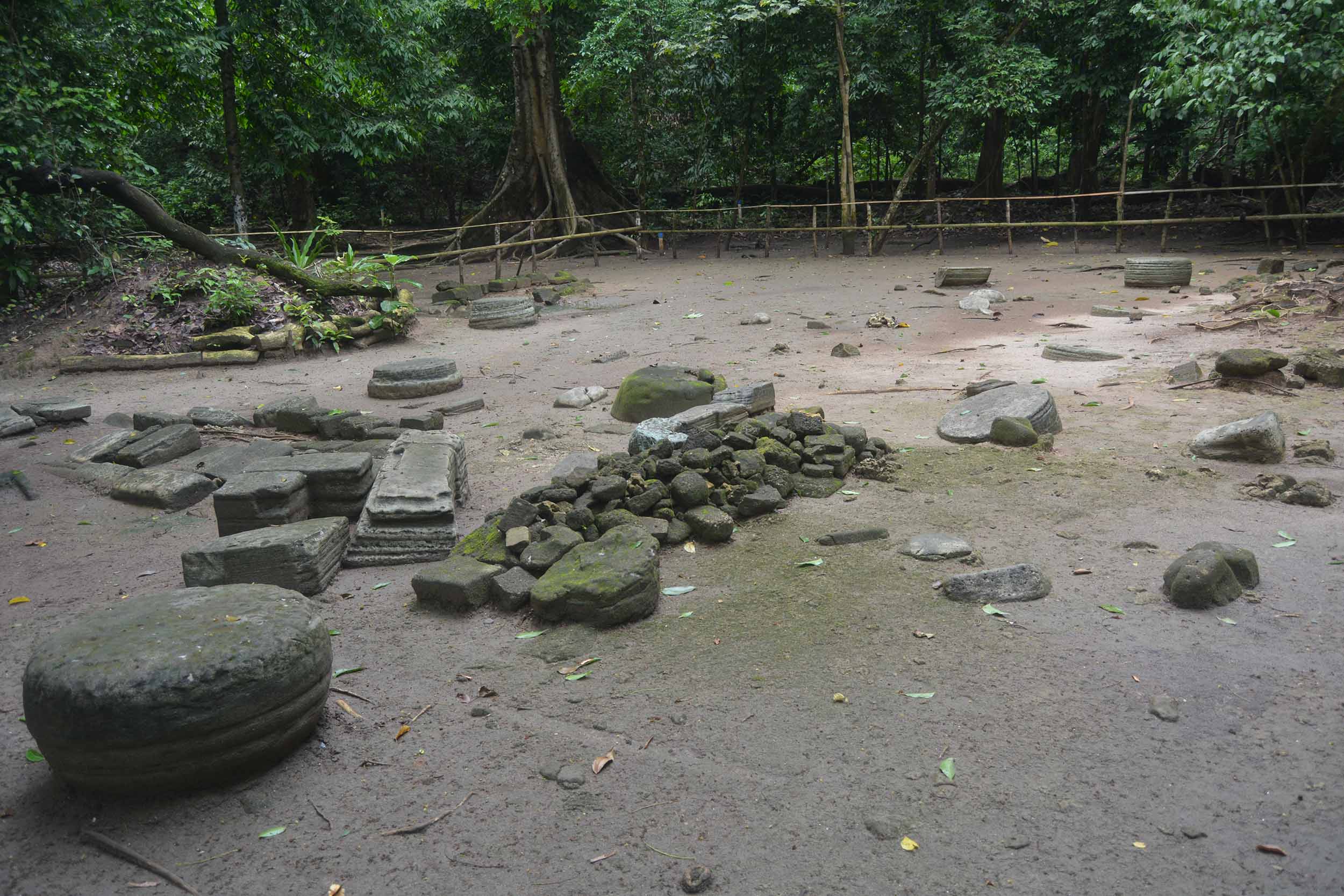
These objects clearly show that the building that used to stand on the site, of course, had Hinduism in it, and it was even alleged that the building was called Pananjung Temple.
Citing the travel report of the priest Bujangga Manik in the 15th century AD, after returning from Central and East Java, it was stated that he stopped at a village called Pananjung which was located at the beginning of a promontory jutting into the southern sea, so the village was called Pananjung. It is possible that Bujangga Manik, the Sundanese Hindu priest, has visited the Kalde Stone Site.
The results of surface observations stated that the building had a square plan with a size of 12 x 12 meters. The remaining part of the building is now composed of three layers of stone. However, during the observation, it was not possible to know the direction it was facing, because there was no viewer found on one side, as is the case with temple buildings in general.
It is possible that the building of the Pananjung Temple is not like the temples in Central or East Java. This can be seen from the thickness of the building structure, the type of stones, and also the depth of the foundation. If the Pananjung Temple building has a roof, it is likely to be made of materials that break down quickly, such as wooden poles, bamboo, and roof coverings made of palm fiber.
According to local sources, Arca Nandi or often called Batu Kalde or Sapi Gumarang (1mx1mx0.6 m) was a place of worship for Hindus during the Pananjung Kingdom (Galuh Tanduran). Apart from that, there are also 5 ancient tombs which are thought to be the tombs of Pananjung’s dignitaries.